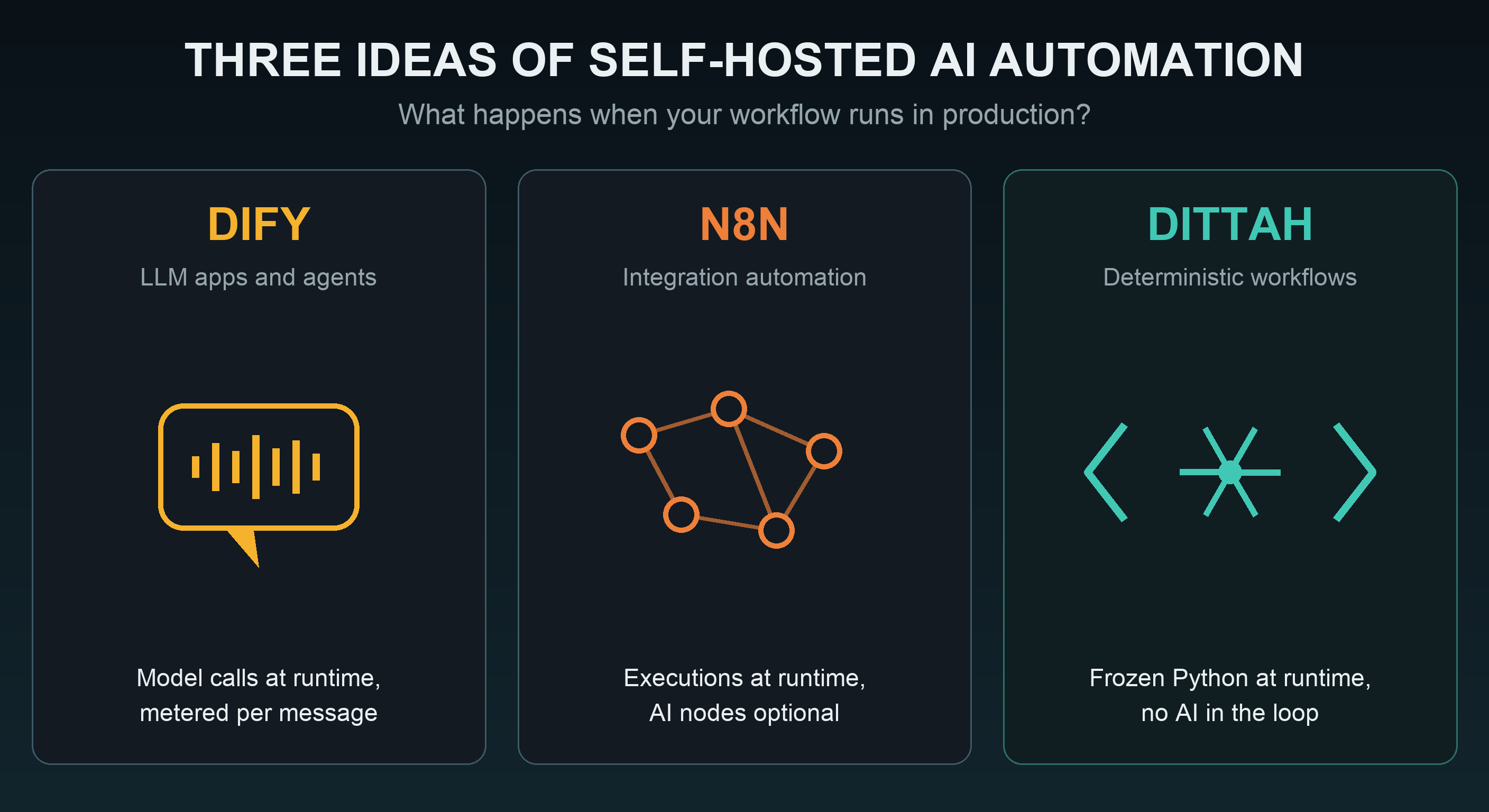
If you're evaluating self-hosted AI automation, three names keep coming up: Dify, n8n, and us. From a distance they look interchangeable. Up close they are built around different ideas of what automation should be, and picking the wrong one means discovering that six months in.
Full disclosure: we make Dittah, so read accordingly. But this comparison is built on each platform's own license files, pricing pages, and documentation (checked June 2026), and where Dify or n8n is the better choice, we say so. The fastest way to lose your trust is to pretend a 192,000-star project has no reason to exist.
The 60-Second Answer
- Pick Dify if you're building LLM-native applications: chatbots, RAG knowledge assistants, AI agents your end users talk to. That's what it's designed for.
- Pick n8n if you need general-purpose integration plumbing: moving data between SaaS tools, reacting to webhooks, orchestrating APIs, with AI steps mixed in where useful. Its integration library and community are the largest of the three by far.
- Pick Dittah if your workflows produce numbers someone has to sign off on. Reports, reconciliations, regulatory outputs, anything where the same input must produce the same output every single time, with code an auditor can read.
If that already settled it for you, you're done. The rest of this article is the detail behind those three sentences, and it covers the two questions most comparisons skip: what each license actually permits, and what happens at runtime.
The Real Difference: What Happens at Runtime
Most comparisons rank features. The more useful question is architectural: when your workflow runs in production, is an LLM in the loop?
Dify: yes, by design. Dify applications call models at runtime; that is the product. Its cloud pricing meters "message credits" consumed as users interact with your deployed apps, and if you bring your own API key you pay the provider per call instead. For a chatbot this is exactly right, since every conversation is new. For a repeated data workflow it means every run costs tokens and every output can vary.
n8n: optional, per node. n8n is a workflow engine first. Plenty of n8n workflows never touch a model, and its deterministic nodes (HTTP, transforms, database steps) behave like ordinary code. Add an AI Agent node, though, and that step calls a model on every execution, with the same cost and variability consequences.
Dittah: no, by design. AI is used at design time only. You describe the workflow in plain English, AI generates Python you can read, and publishing freezes that code into a versioned, immutable artifact. Production runs execute the frozen code with no LLM calls at all: same input, same output, zero runtime token spend. We've written up the cost math of that difference separately, and you can watch it happen in the demo video.
None of these is wrong. They're answers to different questions. A customer-facing assistant needs a model at runtime. A month-end close does not, and putting one there adds cost and variance you then have to explain to an auditor.
Licensing: What "Self-Hosted" Actually Permits
All three platforms can run on your own servers. What you're allowed to do with them differs more than most evaluations notice, and none of the three is OSI-standard open source.
| Dify | n8n | Dittah | |
|---|---|---|---|
| License | Modified Apache 2.0 with added conditions | Sustainable Use License (fair-code), plus Enterprise License for ".ee." source files | Free Community edition under EULA |
| Internal business use, self-hosted | Allowed, single tenant | Allowed | Allowed for personal use and evaluation; commercial tiers for teams |
| Key restrictions | No multi-tenant operation without a commercial license; can't remove Dify branding when using its frontend | No selling access, hosting for paying customers, or white-labeling; ".ee." enterprise files need a paid license in production | Single tenant; multi-tenant and commercial team use require Professional or Enterprise |
The details matter. Dify's license permits commercial single-tenant self-hosting, but the moment you serve multiple tenants from one deployment you need written authorization, and its definition of a tenant is one workspace. n8n's Sustainable Use License is generous for internal automation, but parts of the codebase carry ".ee." markers and legally require an Enterprise License to run in production. If a feature you're counting on lives in one of those files, "free self-hosted" quietly stops applying. We're not criticizing either choice; sustainable licensing is a real problem for open products. But read the license before you build on any of us, ours included.
Pricing, as of June 2026
Figures below come from each vendor's official pricing page, checked June 12, 2026. They will drift; treat this as a snapshot and verify before deciding.
| Dify | n8n | Dittah | |
|---|---|---|---|
| Free tier | Sandbox: 200 one-time message credits, 1 member, 5 apps; self-hosted Community edition | Community Edition, self-hosted, unlimited executions | Community edition: full Chat Studio and Build Studio, single tenant, self-hosted |
| Paid cloud | Professional $59, Team $159 per workspace/month, metered in message credits | Starter €20, Pro €50 per month billed annually, cloud-only | Not applicable; Dittah is self-hosted or deployed for you |
| Paid self-hosted | Enterprise: unpublished, contact sales | Business €667/month billed annually, or custom Enterprise | Professional: quoted per team; Enterprise: custom |
| Runtime metering | Message credits, or provider tokens with your own key | Workflow executions per month on paid plans | None. Frozen code has no per-run token cost |
Two things stand out. First, the metering models tell you what each product expects to happen at runtime: Dify counts model calls, n8n counts executions, Dittah counts nothing because frozen Python doesn't bill by the run. Second, paid self-hosting has a steep entry on the others: n8n's first paid self-hosted tier is the €667/month Business plan, and Dify doesn't publish a number at all.
What the Free Tier Leaves Out
Free self-hosted editions are how all three of us earn trust, so it's fair to ask what each one withholds.
n8n's Community Edition excludes, per its own documentation: SSO, Git-based version control, environments, external secrets management, log streaming, projects, and workflow or credential sharing. Those are exactly the features a compliance review asks about, and they require Enterprise editions or paid cloud plans. Dify's cloud tiers gate role management, unlimited log history, and access to its SOC 2 Type II report behind the $159 Team plan; its self-hosted Community edition is licensed separately, as covered above.
Dittah's Community edition includes the full Chat Studio and Build Studio experience for a single tenant. The line we draw is tenancy and team scale, not capability: multi-tenant architecture and tenant-isolated role-based access control arrive with Professional. Versioned frozen code and execution logging are part of the architecture itself, so they exist in every edition. The pricing page has the full breakdown.
Community and Maturity
Honesty requires this section. n8n has over 192,000 GitHub stars and one of the largest automation communities anywhere. Dify is close behind at roughly 145,000. Both numbers were checked in June 2026 and both represent years of momentum, thousands of contributors, and answers to nearly any question already on a forum somewhere.
Dittah is the newcomer, and we won't pretend otherwise. What we offer instead is a focused bet: that regulated industries need automation built deterministic-first rather than retrofitted with guardrails, and a free Community edition so you can test that bet on your own servers without speaking to sales.
The Regulated-Industry Checklist
If you operate in finance, insurance, or anywhere else with auditors, these are the questions that separate the three platforms in practice:
- Will the same input produce the same output next quarter? With a model in the runtime loop, that's hard to guarantee. With frozen code, it's the default.
- Can you show an auditor exactly what produced a number? Dittah's answer is the frozen, versioned Python itself plus the execution log. With agent-style runtime AI, the answer involves explaining a model's behavior at a point in time.
- What does run number 100,000 cost? Metered models scale costs with your success. The token math is worth doing before you commit, whichever platform you choose.
- Are the governance features in the edition you're actually deploying? Check the gating tables above against the edition you plan to run, not the one in the demo.
Bottom Line
Dify is the strongest choice for building LLM applications. n8n is the strongest choice for broad integration automation. Both are capable, well-maintained platforms with enormous communities, and if your use case matches theirs, use them with our blessing.
Dittah exists for the use case neither was designed around: workflows where AI's creativity is welcome at design time and intolerable at runtime. If that's your world, watch the demo and build your first workflow, or download the free Community edition and test it against your messiest recurring report. The comparison that matters most is the one you run yourself.
Sources: each platform's official license file, pricing page, and documentation, reviewed June 12, 2026. Licensing summaries are informational, not legal advice; always read the current license text before deploying.