The enterprise AI landscape is shifting. After years of hype, organizations are getting pragmatic about what AI can and can't do in production environments. Here are the trends we see defining enterprise automation this year.
1. The Rise of Deterministic AI
The biggest barrier to AI adoption in enterprises has never been capability. It's been predictability. When a finance team runs a regulatory report, they need identical outputs from identical inputs. Every time. No exceptions.
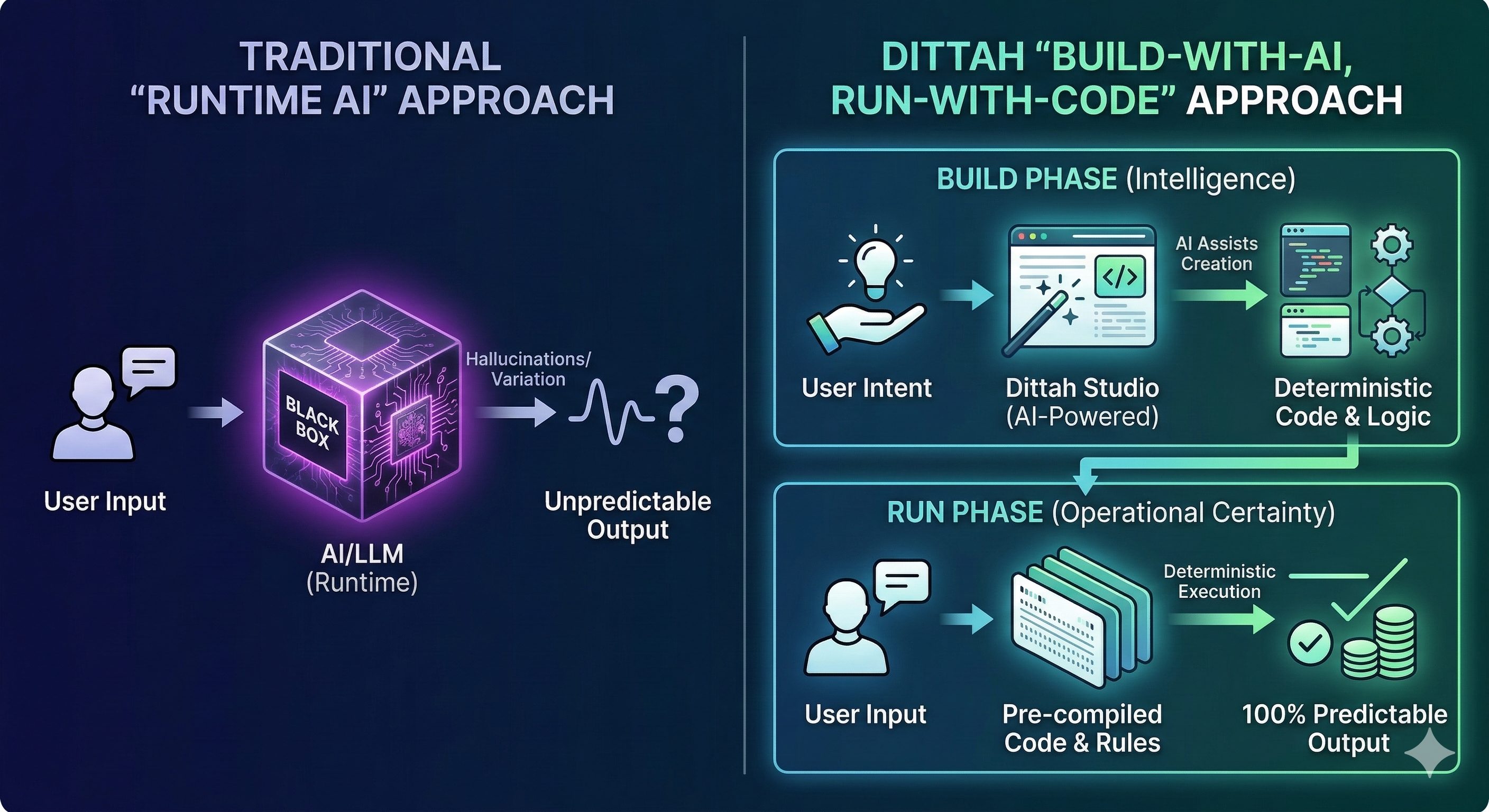
This is driving a fundamental shift in how companies think about AI. Instead of using AI at runtime (where outputs can vary), forward-thinking teams are adopting a build-with-AI, run-with-code approach. AI assists in creating the solution (understanding intent, generating logic, writing transformations), but the final execution is pure deterministic code.
The result? Teams get the speed and intelligence of AI during development, with the reliability of traditional software in production.
2. On-Premise LLMs Go Mainstream
Regulatory pressure and data sovereignty requirements are pushing enterprises toward self-hosted AI. Models like Qwen, Llama, and Mistral now deliver strong performance on standard server hardware, making on-premise deployment viable for mid-size organizations, not just tech giants.
For compliance-driven industries like financial services and insurance, this is transformative. Document intelligence and workflow automation can now run entirely within the corporate firewall, with zero data leaving the network.
There's a cost angle too. When workflows are frozen into deterministic code, there are no LLM token charges at runtime. Pair that with a self-hosted model, and you eliminate the unpredictability of cloud AI billing entirely: fixed infrastructure costs, no surprise bills, no vendor lock-in.
3. AI-Powered Workflow Creation Replaces Low-Code
Traditional low-code platforms require users to learn a visual programming paradigm of dragging blocks, configuring parameters, and understanding data flows. Natural language workflow creation is replacing this entirely.
Instead of learning a tool's interface, users describe what they want: "Take this Excel, calculate year-over-year growth per region, and generate a PowerPoint using our branded template." AI translates intent into executable logic. The skill required shifts from "knowing the tool" to "knowing what you need."
4. Document Intelligence Becomes Table Stakes
The ability to ask questions across thousands of documents (contracts, policies, reports, manuals) is moving from "nice to have" to essential infrastructure. Organizations are building private knowledge engines that give teams instant answers from their own data, with role-based access ensuring the right people see the right information.
The key differentiator is source citation. Enterprise users don't just want answers; they want to know exactly which document, which page, which paragraph the answer came from. Verifiability is non-negotiable.
5. Audit Trails Are the New Competitive Advantage
As AI becomes embedded in business processes, the ability to prove every input, every transformation, and every output becomes a competitive advantage. Organizations that can demonstrate full traceability to regulators, auditors, and clients build trust faster.
This goes beyond logging. It means deterministic execution (so results are reproducible), versioned workflows (so you can explain exactly what code produced a given output), and role-based access controls (so you can prove who had access to what).
Where This Is Heading
The common thread across these trends is a maturation of how enterprises think about AI. The question has shifted from "Can AI do this?" to "Can AI do this reliably, securely, and auditably?"
Organizations that figure out how to harness AI's intelligence while maintaining operational certainty will pull ahead. Those that treat AI as a runtime black box will continue to struggle with adoption.
The future of enterprise automation isn't more AI. It's smarter boundaries around where and when AI operates.
At Dittah, we didn't just follow these trends; we built our architecture around them. We believe the "Black Box" era of enterprise AI is over. It's time to build with intelligence and run with the absolute certainty of code.